Summary
- Dermatology makes up about 0.2% of the 1,614 artificial intelligence-enabled devices on the Food and Drug Administration's list, which is 76% radiology.
- All four dermatology entries came through premarket approval or De Novo rather than 510(k) clearance, so none relied on a predicate device.
Abstract
Background: The US Food and Drug Administration (FDA) has no dermatology review panel, so dermatology's share of its artificial intelligence (AI)-enabled device list, and the skin tone evidence behind those devices, are unknown.
Objective: To measure dermatology's share of FDA's AI-enabled device list and characterize its regulatory pathways, AI labeling, and change control plans.
Methods: Cross-sectional analysis of FDA's list (1,614 entries through June 29, 2026). Dermatology-relevant devices were identified by product code, regulation, and name, and their FDA documents were read for AI wording, change control plans, and skin tone terms. Data were collected November 6 to 15, 2026.
Results: Entries rose from 18 in 2016 to 335 in 2025; 76.2% were radiology. Four (0.2%) were dermatology-relevant. All four were authorized by premarket approval or De Novo, versus 3.8% of all entries. Of the four, FDA described two as AI, none had a change control plan, and one reported performance by skin tone.
Limitations: Very small dermatology subset; non-comprehensive list; public documents only.
Conclusions: Dermatology is a tiny, atypically regulated share of FDA's AI-enabled devices, none has a change control plan, and the list cannot be searched by specialty.
Introduction
Artificial intelligence (AI) is entering medicine through US Food and Drug Administration (FDA) device pathways, and FDA publishes a list of AI-enabled devices.1 How much of that list concerns dermatology is not known. FDA organizes devices by review panel, product code, and regulation, and it has no dermatology panel. Skin devices are reviewed mainly under General and Plastic Surgery (21 CFR Part 878), so the list cannot be filtered for dermatology.
Prior audits show how thin demographic reporting is in this setting. A review of 692 FDA-authorized AI-enabled devices found that 3.6% reported race or ethnicity.2 A review of 70 dermatology AI studies found that 10.0% gave any information about skin tone in at least one data set.3 Earlier work examined how medical AI devices are evaluated in FDA approvals across specialties.4
These studies covered all specialties or the published literature. Two dermatology reports are closest: a commentary comparing dermatology with other specialties among FDA-cleared software devices7 and a review of approved dermatology AI applications that identified three FDA-approved systems.8 A comparable specialty analysis of FDA's list exists for urology.9 To our knowledge, none has measured dermatology's share of FDA's AI-enabled device list or compared the authorization documents of its dermatology devices for pathway, change control plans, and skin tone reporting. We used the list as the denominator, identified dermatology-relevant devices on it, and described their regulatory pathways, how FDA labels their software, whether any has an authorized change control plan, and whether each reported skin tone.
Methods
Design. Cross-sectional analysis of FDA's public AI-enabled device list and, for dermatology-relevant entries, the underlying FDA regulatory documents. No human subjects were involved.
Denominator. We downloaded FDA's AI-enabled device list as a CSV on 21 November 2026.1 It held 1,614 entries (decision dates 29 September 1995 to 29 June 2026), each with a submission number, device, company, lead review panel, and primary product code. We counted entries by decision year, lead panel, and primary product code. The submission number prefix gave the pathway (K, 510(k); DEN, De Novo; P, premarket approval). A 510(k) requires a predicate and De Novo and premarket approval do not, so we used pathway as our measure of predicate use.
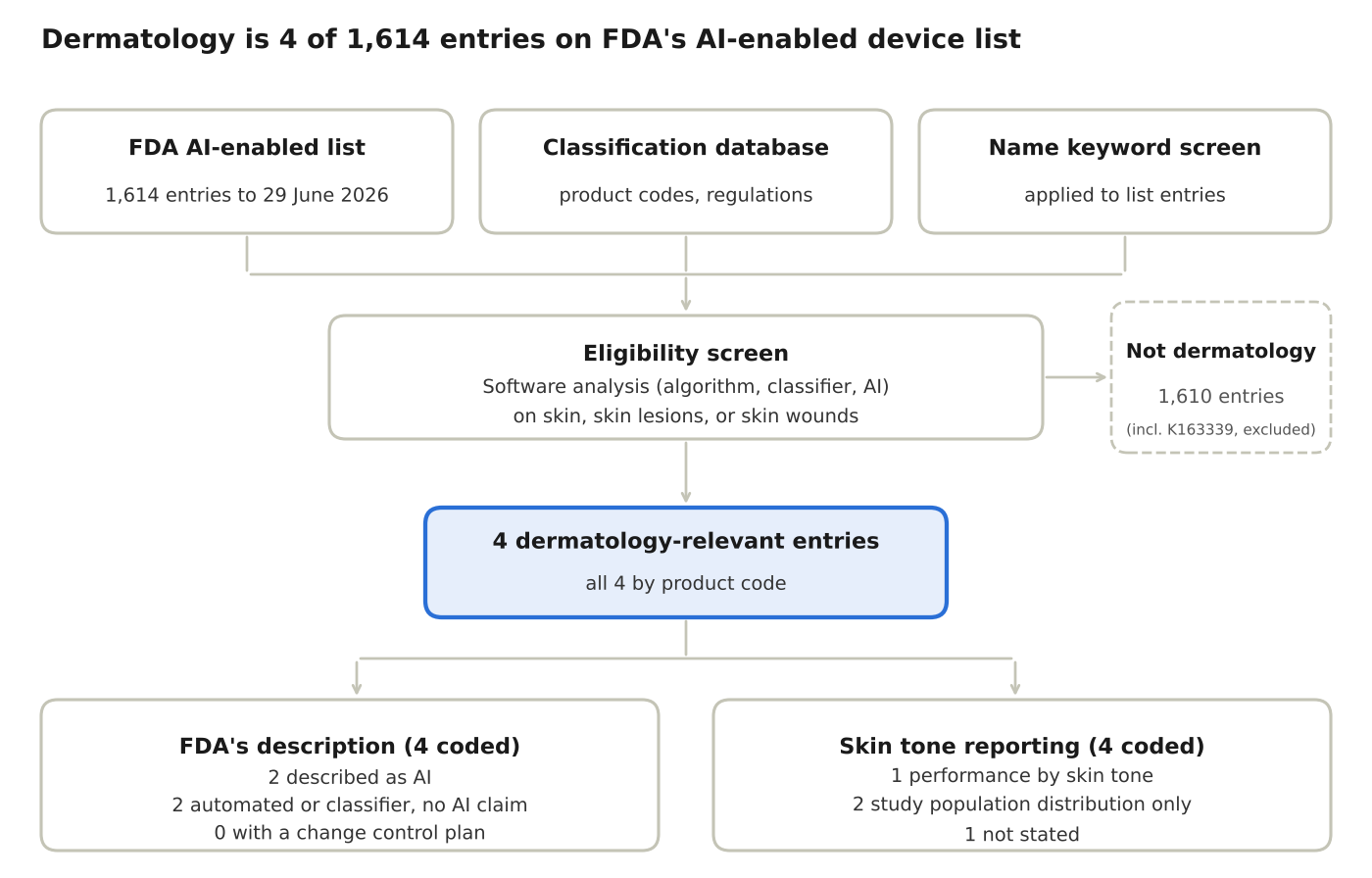
Dermatology-relevant devices. Because FDA has no dermatology panel, we identified dermatology-relevant entries without a specialty filter (Figure 1). We screened the list by six product codes drawn from skin regulations (QZS, SHY, QJF, QDG, OYD, ONV; 21 CFR 878.1820, 878.1830, 878.1840, 878.4550) and by skin-related name keywords (for example skin, lesion, melanoma, wound, burn, acne, hair, aesthetic). We also read every General and Plastic Surgery and Pathology entry. An entry was eligible if its software performed an analytic function (an algorithm, classifier, or AI) on skin, skin lesions, or skin wounds. We excluded keyword matches with other indications, general-purpose pathology software, and one 2017 wound perfusion imager regulated as a blood-flow probe under Cardiovascular (SpectralMD DeepView Wound Imaging System 2.0, K163339), because it has no skin-specific regulation, no AI wording in its FDA summary, and no clinical study. We made this exclusion after reading its 510(k) summary. Authorizations absent from the list were outside the cohort, including imaging-only systems without an analytic function (fluorescence wound cameras and dermatoscopes) and a digital pathology clearance, AISight Dx (K243391). Consumer skin-analysis systems without an FDA authorization, such as Canfield's VISIA and Perfect Corp's YouCam, also fall outside the cohort; a search of the openFDA 510(k) database (data through 26 October 2026) found no clearance under either company's name, and FDA's De Novo database (searched 21 November 2026) listed none.
Source documents and verification. For each dermatology-relevant entry we read the clearance letter, De Novo granting order, premarket approval order, and the summary of safety and effectiveness or decision summary where FDA posted one. FDA's query pages sometimes return a mismatched record, so we confirmed that the submission number printed inside each document matched the device before abstracting any field.
Other databases. For each dermatology-relevant entry we searched openFDA for adverse event reports (MAUDE; data updated 4 November 2026), recalls (updated 12 November 2026), and 510(k) and premarket approval records, and searched ClinicalTrials.gov by device and sponsor name. Adverse event reports are voluntary and brand name searches can miss reports, so we report counts, not rates. We took Breakthrough Devices designation and European and UK marking from company statements, which we did not verify in FDA, EUDAMED, or MHRA registers.
Variables. We recorded decision date, pathway, device class, product code, regulation, review panel, and clinical category. We recorded how FDA's own documents describe the software, using FDA's words (for example "artificial intelligence," "classifier," or "algorithm"). We recorded whether FDA's database shows an authorized predetermined change control plan (PCCP).
Skin tone reporting. Each document was searched for Fitzpatrick, skin tone, skin type, skin color, race, ethnicity, phototype, melanin, pigment, pigmentation, dark skin, and complexion. Documents with no hit were searched a second time with differently worded terms. Each authorization was then placed in one of three categories: performance reported by skin tone or phototype; skin tone or phototype distribution of the study population reported without stratified performance; or not stated. We recorded "not stated" rather than leaving a blank, so that FDA's silence was not read as a negative finding. The tracker's published grades were collapsed as follows: A (performance stratified by skin tone) became the first category; B and B/C (distribution reported, no stratified performance; B/C adds an FDA caution about darker skin) became the second; D (not stated) became the third. The A to D scale was proposed and first applied during an AI-assisted rebuild of the dataset on 6 November 2026.
Analysis. Descriptive counts only. Authorizations that FDA reclassified during the study period were counted under their current regulation.
Results
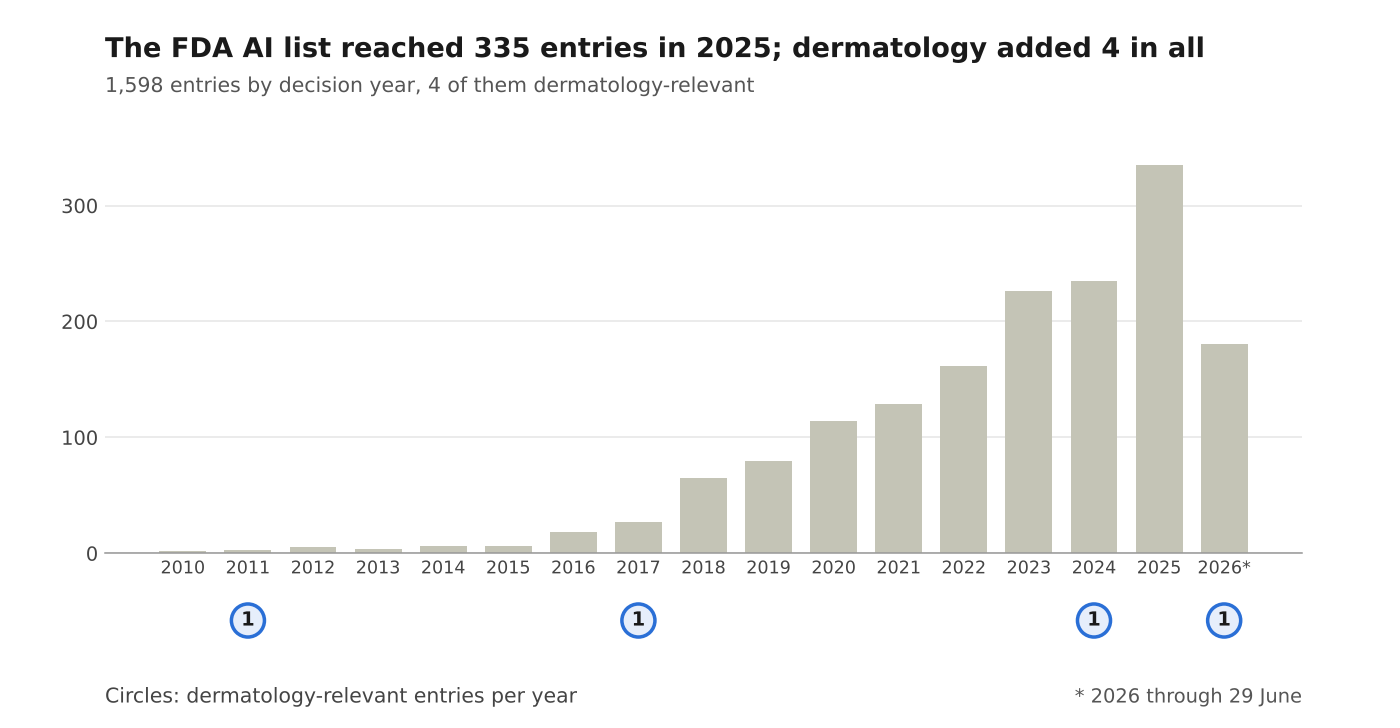
List. FDA's list held 1,614 entries across 18 lead panels and 181 primary product codes. Only 42 were decided before 2016. Annual entries rose from 18 in 2016 to 65 in 2018, 162 in 2022, and 335 in 2025, and 181 were decided in the first half of 2026 (Figure 2). Radiology accounted for 1,230 entries (76.2%), followed by Cardiovascular (154; 9.5%), Neurology (73; 4.5%), Anesthesiology (30; 1.9%), and Gastroenterology-Urology (27; 1.7%). General and Plastic Surgery and Pathology each held fewer than 1% (9 and 10 entries). By pathway, 1,553 entries (96.2%) were 510(k) clearances, 40 (2.5%) were De Novo grants, and 21 (1.3%) were premarket approvals.
Dermatology-relevant entries. Four entries (0.2%) were dermatology-relevant (Table 1): MelaFind (2011), Nevisense (2017), DermaSensor (2024), and DeepView AI (2026). All four matched a dermatology product code under General and Plastic Surgery. Three assessed skin lesions and one assessed burn wounds. Two were premarket approvals and two were De Novo grants; none was a 510(k) clearance. All four therefore came through routes with no predicate, against 61 of 1,614 entries (3.8%) overall. The two premarket approvals (MelaFind and Nevisense) print no class in any FDA document they cite. FDA reclassified their product codes from Class III to Class II effective 24 April 2026,5 which created 21 CFR 878.1820. No other General and Plastic Surgery or Pathology entry was dermatology-relevant. One entry found by name, the 2017 SpectralMD DeepView Wound Imaging System 2.0 (K163339), was excluded (Methods).
AI labeling. All four entries are on FDA's list by definition. FDA's documents describe two of them (DermaSensor and DeepView AI) as AI: DermaSensor's decision summary calls it an "AI/ML-based software algorithm," and DeepView AI's indication uses the words "artificial intelligence." MelaFind and Nevisense are described as automated or classifier products with no AI or machine learning claim.
Change control. None of the four dermatology devices has an authorized predetermined change control plan. AISight Dx, the pathology clearance outside the cohort, does; its scope is limited to interoperable displays, scanners, file formats, and web browsers.
Postmarket and registry records. DermaSensor had 11 adverse event reports, all malfunctions, received between 29 December 2025 and 9 February 2026 (7 on one day). We found none for MelaFind, Nevisense, or DeepView. DermaSensor has an open Class II recall, initiated 13 October 2025 for software version 3.0.2, because the device might not meet specifications and could give incorrect results or delay referral. MelaFind had a Class II recall in 2015, now terminated, because probability and histogram data in its display were not covered by its approval supplement. ClinicalTrials.gov listed DermaSensor's pivotal study (NCT06690086; 1,028 participants) and a recruiting postmarket study (NCT06666790; 396 participants). MelaFind's postmarket approval study (NCT01700114; 487 enrolled) is listed as terminated. Nevisense's pivotal study (NCT01077050) enrolled 1,951. SpectralMD registered several DeepView burn and wound studies.
Other jurisdictions. Products authorized abroad were absent from FDA's list. Skin Analytics' DERM (Class III CE marking under the EU Medical Device Regulation, with FDA Breakthrough designation per the company) and SkinVision (Class IIa) had no 510(k) record in openFDA and no entry on the list. DermaSensor reports Class IIb CE marking (June 2026) and received Breakthrough designation in 2021.
Skin tone reporting. Of the four devices, one (25%) reported performance by phototype (DermaSensor), two (50%) reported the phototype distribution of the study population without stratified results (MelaFind and Nevisense), and one (25%) stated nothing (DeepView AI) (Table 1). DeepView AI's entry reflects that only its granting order was available to us, not confirmed FDA silence.
| Device (submission no.) | Year | Pathway | Product code | Panel | Category | FDA's description of the software | PCCP | Skin tone reporting |
|---|---|---|---|---|---|---|---|---|
| MelaFind (P090012) | 2011 | PMA | OYD | GPS | Skin lesion | "Automated," "classifier algorithm" | No | Distribution only |
| Nevisense (P150046) | 2017 | PMA | ONV | GPS | Skin lesion | "Classifier," "algorithm" | No | Distribution only |
| DermaSensor (DEN230008) | 2024 | De Novo | QZS | GPS | Skin lesion | "AI/ML-based software algorithm" | No | Stratified |
| DeepView AI System (DEN250028) | 2026 | De Novo | SHY | GPS | Burn wound | "Using artificial intelligence" | No | Not stated |
GPS, General and Plastic Surgery; PCCP, predetermined change control plan; PMA, premarket approval.
Discussion
In FDA's AI-enabled device list, dermatology-relevant devices were about 0.2% of 1,614 entries, in a list that is three-quarters radiology and added 335 entries in 2025 alone. Dermatology's devices were also regulated differently from the rest: all four came through premarket approval or De Novo, against 3.8% of the list overall, so none relied on a predicate. Skin tone reporting was uneven: of the four devices, only one reported performance by skin tone, in line with broader audits of FDA-authorized AI devices.2
Three features of the regulatory system shape these results. First, dermatology has no panel, so the specialty's devices sit in General and Plastic Surgery, and FDA's list cannot be filtered by specialty. Dermatologists who want to know what is authorized must search by product code and keyword, as we did. Second, inclusion on FDA's list did not track FDA's own description of the software. Two of the four devices are described as automated classifiers with no AI or machine learning claim, yet appear on the list, so a reader using the list as a proxy for AI would count differently depending on the source. Third, none of the dermatology devices has an authorized change control plan. For devices that may be retrained, the plan is where a sponsor commits to monitoring performance across populations.
The skin lesion regulations are changing in ways that could help. FDA now has a family of regulations for software-aided skin lesion diagnosis (21 CFR 878.1820 and 878.1830) and skin wound assessment (878.1840). DermaSensor's classification order expects a postmarket study that overrepresents phototypes IV to VI and records race and socioeconomic status. That expectation is a template. Equivalent data requirements in the other regulations in the family, and in future devices submitted under them, would make phototype reporting routine rather than exceptional. Devices for adjacent skin cancer tasks are also absent: no margin assessment or Mohs surgery tool is on the list, although at least one machine learning device for excised basal cell carcinoma specimens has been described and is not yet authorized.6 We also suggest that FDA add a specialty or anatomic tag and a skin tone field to its AI-enabled device list and public decision summaries, and that sponsors report stratified results with confidence intervals and state plainly when a subgroup is too small to estimate.
Our results should be read with several limits in mind. The dermatology subset is very small and was identified by product code and keyword screens because no specialty filter exists, so another reviewer could have drawn a different set. FDA's list is non-comprehensive and lags authorizations: its newest entry was dated 29 June 2026 when we checked, so devices not yet listed may later appear. Devices absent from it, such as the pathology clearance AISight Dx and imaging-only wound or dermatoscope systems, are outside the cohort. Pathway is an imperfect proxy for predicate use, and the list carries no data on clinical validation, so we examined validation only for dermatology devices and only as FDA posted it. We analyzed what FDA posted, not what sponsors submitted. Summaries for 510(k) clearances are short, and some contain no clinical performance section, so "not stated" means absent from the public record, not absent from the submission. For DeepView AI only the granting order was available. We excluded K163339 after reading its summary, a judgment other reviewers might make differently. We did not test any device independently. The cohort covers FDA marketing authorizations only. Widely marketed facial skin-analysis tools with AI features, such as VISIA and YouCam, appear to have no authorization, so their performance across skin tones sits outside FDA's public record.
In conclusion, dermatology is a very small share of FDA's fast-growing list of AI-enabled devices, its devices mostly came through premarket approval or De Novo rather than 510(k), and none has a change control plan. Dermatologists, patients, and sponsors would be better served if FDA's list could be searched by specialty and if sponsors disclosed change control plans.
References
- US Food and Drug Administration. Artificial intelligence-enabled medical devices. https://www.fda.gov/medical-devices/software-medical-device-samd/artificial-intelligence-enabled-medical-devices. Page last modified 4 September 2026. CSV downloaded 21 November 2026.
- Muralidharan V, Adewale BA, Huang CJ, et al. A scoping review of reporting gaps in FDA-approved AI medical devices. NPJ Digit Med. 2024;7(1):273. doi:10.1038/s41746-024-01270-x
- Daneshjou R, Smith MP, Sun MD, Rotemberg V, Zou J. Lack of transparency and potential bias in artificial intelligence data sets and algorithms: a scoping review. JAMA Dermatol. 2021;157(11):1362-1369. doi:10.1001/jamadermatol.2021.3129
- Wu E, Wu K, Daneshjou R, Ouyang D, Ho DE, Zou J. How medical AI devices are evaluated: limitations and recommendations from an analysis of FDA approvals. Nat Med. 2021;27(4):582-584. doi:10.1038/s41591-021-01312-x
- US Food and Drug Administration. Final order reclassifying product codes ONV and OYD. 91 Fed Reg 14445 (FR Doc 2026-05772), published 25 March 2026, effective 24 April 2026. https://www.federalregister.gov
- Ceres DM, Gharia MJ, Harvey K, Quinn N. Machine learning-guided bioelectrical impedance mapping for rapid adjunctive margin assessment in Mohs surgery. npj Biomed Innov. 2026;3:47. doi:10.1038/s44385-026-00095-5
- Vidal NY, Sidey K, Kim YH, Vidal DE. Artificial intelligence in medicine - dermatology compared to other medical specialties in FDA-cleared software as medical device. Dermatol Online J. 2023;29(2). doi:10.5070/D329260766
- Nahm WJ, Sohail N, Burshtein J, Goldust M, Tsoukas M. Artificial intelligence in dermatology: a comprehensive review of approved applications, clinical implementation, and future directions. Int J Dermatol. 2025;64(9):1568-1583. doi:10.1111/ijd.17847
- Qian Z, Brin P, Korn S, et al. Artificial intelligence in urology: a review of United States Food and Drug Administration-cleared devices. BJU Int. 2026;138(3):424-429. doi:10.1111/bju.70345
Declarations
Conflicts of interest: The author has no relationship with NovaScan, whose study is cited. The author was formerly a consultant for MelaFind, one of the devices analyzed.
Data availability: The FDA list analyzed (CSV downloaded 21 November 2026), the dermatology screen, and the device-level coding with links to each FDA source document are maintained as an open tracker at beautytechderm.com/derm-ai-device-tracker and can be provided as supplemental tables.
Declaration of generative AI use: Draft prepared with assistance from Claude (Anthropic); the author reviewed and takes responsibility for all content.